
FAQ on Washington’s Renters Right to Cooling Law 6200
What does this new law say?
Beginning June 11, 2026, Washington renters have the right to install most forms of portable cooling devices of their choosing to stay safe and cool during summer heat swells. The law—ESSB 6200—covers both residential tenants under the Residential Landlord-Tenant Act (RCW 59.18) and mobile home park tenants under the MHLTA (RCW 59.20). Governor Ferguson signed the bill on March 24, 2026.
How does the law define what a “Portable Cooling Device” is?
The law defines “portable cooling device” as an air conditioner or portable heat pump, including window-mounted and floor-standing units. The bill identifies three device categories with different rules for each:
Window-Mounted Devices: Units installed to sit in a window opening. Subject to the most restrictions, notice requirements, and inspection provisions.
Saddle-Mounted Devices: Units (including U-shaped models) that hang over the windowsill with interior and exterior components, leaving the window view partially unobstructed. These are explicitly excluded from the “window-mounted” category and its additional restrictions.
Floor-Mounted Devices: Freestanding units connected to a window for venting. Also excluded from the window-mounted restrictions.
Note: The law covers air conditioners and heat pumps. Evaporative coolers (swamp coolers) are not specifically addressed in the statute and may not be covered.
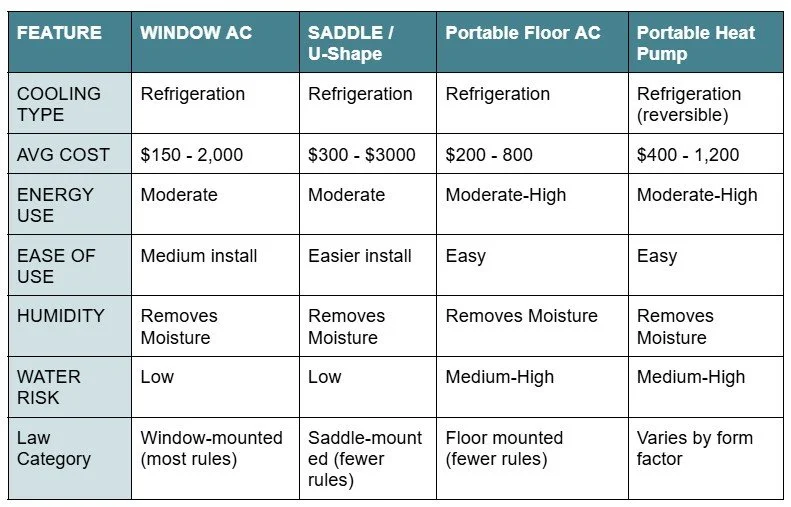
Quick Breakdown of Portable Cooling Devices
Here is a quick breakdown of the types of portable cooling devices that tenants may consider when thinking about purchasing a cooling unit.
What if a tenant’s lease says they cannot install a portable cooling device?
If a tenant’s lease states that you cannot install a portable cooling device or a window-mounted device, the landlord must notify tenants in their leases of their rights, responsibilities, and any restrictions. A lease addendum is a simple fix for this.
Can a tenant get fined for installing a portable cooling device?
Landlords cannot charge a fee for the use, inspection, or installation of a tenant’s portable cooling device. However, landlords may charge rent for a cooling device rented by the tenant from the landlord. Landlords may also charge for any damages caused by the tenant’s device.
Do tenants need to give notice about the installation?
Yes. Tenants must provide at least two days’ notice before installing a window-mounted device. (No notice requirement for floor or saddle-mounted units.)
Will the installation require an inspection?
The law does not require it. But a landlord may require that window-mounted devices be inspected or serviced after installation.
Are there any kinds of AC units that are prohibited?
A landlord may prohibit or restrict any portable cooling device if the dwelling already has a permanently installed and fully operational heat pump, or if installation would:
Violate state or local building codes, state law, or federal law.
Violate the device manufacturer’s written safety guidelines.
Cause unreasonable damage to the premises or render the premises uninhabitable.
Require electrical supply that cannot be accommodated by the existing power service to the building, unit, or circuit.
Additional Restrictions; Window-Mounted Devices Only
Landlords may also restrict window-mounted devices specifically if:
The window is a necessary egress and the device would interfere with its use.
The device would prevent the tenant from locking a window accessible from outside.
The device requires excessive brackets or hardware that would damage or void the window/frame warranty, puncture the exterior wall, or cause significant damage.
The device cannot be secured against falling out of the window.
The landlord’s insurance policy expressly restricts or prohibits window-mounted cooling devices, and the landlord has provided written evidence of the restriction to the tenant.
Landlords may also require that any portable cooling device be adequately drained to prevent damage.
What about window sealing and venting? Is that necessary for a portable cooling device to work?
Sealing the gaps around your window—and also venting your portable cooling device is essential for both effective cooling and also to save money on energy bills. This video has 10 great ideas for how best to vent a portable air conditioning unit.